 Yurlie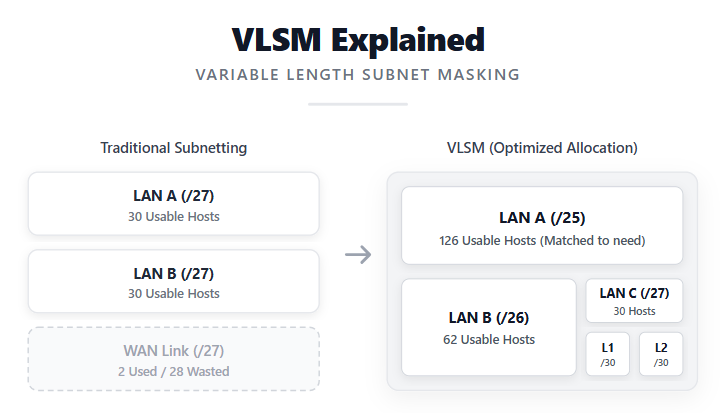
VLSM Explained: Variable Length Subnet Masking
Classic subnetting has a wasteful assumption baked into it: every subnet in a network gets the same size, whether it needs 2 hosts or 200. A point-to-point WAN link that only ever needs 2 usable addresses ends up burning a full /24 with 254 wasted addresses, just because the rest of the network also uses /24. Variable Length Subnet Masking, or VLSM, exists to fix exactly this problem.
VLSM lets you subnet a subnet. Instead of applying one mask across an entire address block, you apply different masks to different parts of it based on how many hosts each segment actually needs. The result is address space that fits the network instead of the other way around.
Why Fixed-Length Subnetting Falls Short
With traditional subnetting, you pick one subnet mask and apply it uniformly. Say you are given 192.168.1.0/24 and need to support 6 subnets. You would borrow 3 bits from the host portion, giving you 8 equal subnets of /27 each, 30 usable hosts per subnet.
That works fine if every subnet genuinely needs around 30 hosts. But real networks are not uniform. A head office LAN might need 100 hosts, a branch office needs 20, and a router-to-router link needs exactly 2. Forcing all of them into the same /27 means the head office runs out of addresses while the point-to-point link wastes 28 of its 30 usable addresses. Across a whole network, this adds up to a lot of unusable space.
How VLSM Solves It
VLSM breaks the one-mask-fits-all rule. You start with your largest subnet requirement, allocate a block sized to fit it, and then subnet the remaining address space again for the next requirement, repeating until every segment has a block just large enough for its host count plus reasonable headroom.
The core rule to remember: allocate from largest to smallest. If you assign small subnets first, you fragment the address space and often cannot fit the larger blocks later, since VLSM subnets need to sit on address boundaries aligned to their own size.
Worked Example
Suppose you are given 192.168.10.0/24 and need to support these segments:
- LAN A: 100 hosts
- LAN B: 50 hosts
- LAN C: 20 hosts
- Link 1 (router to router): 2 hosts
- Link 2 (router to router): 2 hosts
Step 1: Sort requirements from largest to smallest
100, 50, 20, 2, 2.
Step 2: Allocate the largest block first
LAN A needs 100 usable hosts. The smallest block that covers this is a /25, which gives 2^(32-25) - 2 = 126 usable hosts.
- LAN A: 192.168.10.0/25, range 192.168.10.1 to 192.168.10.126, broadcast 192.168.10.127
Step 3: Allocate the next block from what remains
The next available address is 192.168.10.128. LAN B needs 50 hosts, which fits in a /26, giving 62 usable hosts.
- LAN B: 192.168.10.128/26, range 192.168.10.129 to 192.168.10.190, broadcast 192.168.10.191
Step 4: Continue allocating
Next available address is 192.168.10.192. LAN C needs 20 hosts, which fits in a /27, giving 30 usable hosts.
- LAN C: 192.168.10.192/27, range 192.168.10.193 to 192.168.10.222, broadcast 192.168.10.223
Step 5: Allocate the point-to-point links
Next available address is 192.168.10.224. Each link needs exactly 2 usable hosts, which fits in a /30, giving exactly 2 usable hosts.
- Link 1: 192.168.10.224/30, range 192.168.10.225 to 192.168.10.226, broadcast 192.168.10.227
- Link 2: 192.168.10.228/30, range 192.168.10.229 to 192.168.10.230, broadcast 192.168.10.231
Final allocation table
Out of the original /24, addresses from 192.168.10.232 through 192.168.10.255 remain unallocated, ready for future growth without needing to renumber anything already deployed.
The Host Count Formula
For any subnet mask, the number of usable host addresses is:
The minus 2 accounts for the network address and the broadcast address, both of which are reserved and cannot be assigned to a host. The one common exception is /31 links, defined in RFC 3021, which are used specifically for point-to-point connections and treat both addresses in the pair as usable, since there is no broadcast concept needed on a link with exactly two endpoints.
Common Mistakes to Watch For
- Allocating small to large. This is the single most common VLSM error. Starting with your smallest subnets first tends to fragment address space so that larger blocks no longer fit on a valid boundary.
- Forgetting that subnets must align to their own size. A /26 block must start at an address that is a multiple of 64. You cannot just start it anywhere convenient.
- Underestimating growth. Sizing a subnet to the exact current host count leaves zero room to add a single device later without a redesign. Round up to the next power of two with some margin.
- Confusing usable hosts with total addresses. A /30 has 4 total addresses but only 2 usable ones. This trips up a lot of people sizing point-to-point links.
VLSM vs CIDR
VLSM and CIDR (Classless Inter-Domain Routing) are closely related but solve different problems. VLSM is about subnetting within an organization, allocating differently sized blocks to different internal segments. CIDR is about how those blocks get represented and routed, using the prefix notation (like /24 or /27) instead of the old class-based A, B, C system, and how routes can be aggregated to reduce the size of routing tables. In practice, VLSM is what you do when designing a network, and CIDR notation is the language you use to describe the result.
When VLSM Matters Most
VLSM is essential in any network with a mix of segment sizes, which is to say, almost every real network. It matters most in:
- Enterprise networks with departments of varying size
- WAN designs full of point-to-point router links
- ISP address allocation, where wasting address space directly costs money
- Any environment still running on limited IPv4 space, where every wasted address is a real constraint
Calculate Your Own VLSM Allocations Instantly
Skip the manual binary math. Plan subnet boundaries, usable host ranges, and broadcast addresses for every segment in your network with the free Yurlie Subnet Calculator.
Subnet & VLSM Calculator
Partition networks into variable-length subnets without waste
Split IP blocks into subnets with custom host counts and prefix lengths. Perfect for VLSM assignments.
Open Subnet Calculator →